Both documents
Shared spine
PDF §§1–7 and §9 · takeaway Parts I–V and §9.1
Formalization lane · provisional
A self-organizing base drawn from two Grant documents: the Topological Formal Semantics takeaway and the condensed KB (June–August 2026). ATP ch. 14 stays the literature spine for smooth and striated. Nothing here locks a Bridge.
Grant’s direction (2026-09-29): these documents are the basis of the knowledge base (takeaway, condensed KB). The heat-map and spectrum images are pedagogical figures only — see Figures. They are not a top-level category. ATP ch. 14 is not a section of either document; it is the literature spine for the words smooth and striated.
| Document | Scope | Corpus |
|---|---|---|
| Condensed KB (PDF, 6 pp.) | Dialogue synthesis, June–August 2026. Sections 1–9: introduction, core objects, seven theorems, lambda sketch, linguistic mappings, historical resonance, CS implications, a note on fringe patents, synthesis. No Part VI expansion. | lit/grant-seed/topological-formal-semantics-kb.pdf |
| Takeaway (docx) | Same core, then Parts VI–VIII: heat-map strata, reorderable units, non-Abelian holonomy, sheaf / operad / anyon / MTC / 2-group language, and open problems. Subtitle: “From Hybrid Ribbon to Hermetic Triple Integration, and Beyond.” | lit/grant-seed/topological-formal-semantics-takeaway.docx |
Both call the framework Topological Formal Semantics: linguistic structure, geometric form, and event structure treated as projections of one non-orientable, hierarchical object. That is the documents’ thesis. It is not a settled result of this desk, and it is not a joint field with Syntax or Math until Grant and the Chief of Staff say so.
Five registers live on this site. They are not interchangeable. Definitions of smooth and striated stay on the literature spine. Everything numbered as a theorem below is a TFS source assertion.
| Register | What it is allowed to do |
|---|---|
| Literature spine | ATP ch. 14, via the seed primer. Working defs and the mixture caveat. Not collated against the book in this workspace. Working sentences, with that flag, are on Definitions · Sources. |
| Shared source assertion | Stated in both the condensed KB and the takeaway (glyph through CS implications). Reported, not re-proved. |
| Takeaway-only sketch | Parts VI–VIII. Heat map, operator, holonomy, and the later formalisms. The PDF does not contain them. Several are marked open in Part VIII. |
| Background check New 2026-10-06 | Compares standard facts the documents cite or assume (topology, history, linguistics, category theory, patent records) with public references, and gives a verdict: matches, imprecise, standard usage differs, or unverifiable. It never grades Grant’s theorems or readings. Those stay source assertions. See Background checked. |
| Pedagogy | Grant-seed images and the original drawings on this page. They teach a distinction already in the corpus. They are not plates and not definitions. |
The condensed KB (June–August 2026) and the takeaway share one thesis and then diverge. The PDF stops before heat maps. That split is the structure of the formalization, not a ranking of truth.
Both documents
PDF §§1–7 and §9 · takeaway Parts I–V and §9.1
Takeaway only · flagged
Not in the condensed KB. Source sketches, then open problems.
PDF-only, and marked speculative there: the fringe-patent note (§8). It is not part of the shared spine and not part of Part VI.
Teaching figure · original · pedagogy
The fundamental hierarchical operator is the triangled squared circle: outer circle containing an upward triangle, containing a square, containing an inner circle. The takeaway calls this an ancient Hermetic emblem used as a modern formal operator. Nesting as written: outer circle ⊃ triangle ⊃ square ⊃ inner circle.
Background · standard usage differs The nesting order matches the best-documented emblem: Maier, Atalanta fugiens (1617), Emblem XXI, taken from the Rosarium philosophorum (1550). That emblem is early modern, not ancient, and its standard gloss is the philosophers’ stone. Details.
Teaching figure · original schematic · source assertion
lit/grant-seed/media/, unpublished).
| Layer | Element (as synthesized in the docs) | Reading given in the docs |
|---|---|---|
| Outer circle | Macrocosm · Air | Cosmos, spirit, higher consciousness, CP-level closure |
| Triangle | Fire | Transformation; dynamic operator identified with vP / little v |
| Square | Earth | Stability, material realm, body, lexical-thematic domain |
| Inner circle | Water | Fluidity, mind, microcosm, core argument or theme |
The takeaway’s embedded “diagrams” of this glyph are ASCII sketches with broken formula images. They are archived under lit/grant-seed/media/ and are not republished here.
A single continuous ribbon whose centerline is piecewise straight segments and circular arcs, closed under an odd number of half-twists. The documents state that the surface is non-orientable, has one boundary component, has Euler characteristic χ = 0, and is homeomorphic to the standard Möbius strip. Straight segments are read as “square,” arcs as “circle,” one band.
Background · matches Standard references agree. The Möbius strip is non-orientable with one boundary curve and χ = 0. Strips with any odd number of half-twists, or with a knotted centerline, are all homeomorphic to it (not isotopic in space). An even number gives the orientable annulus. Details.
Element assignment, as both documents give it: tetrahedron Fire, cube Earth, octahedron Air, icosahedron Water, dodecahedron Cosmos / Aether. Nesting is said to run by dual pairs and the triangular decompositions of the Timaeus.
Kepler’s Mysterium Cosmographicum (1596) is cited as ordering those solids between planetary spheres. The PDF lists the order it is using: octahedron (Mercury–Venus), icosahedron (Venus–Earth), dodecahedron (Earth–Mars), tetrahedron (Mars–Jupiter), cube (Jupiter–Saturn). The takeaway is shorter (“octahedron (Mercury–Venus), icosahedron, etc.”). In the framework the nesting is called a cosmological-scale projection of the same operator — a reading, not a claim that Kepler intended the linguistic mapping.
Background · matches · flag resolved The PDF’s order is Kepler’s. MacTutor gives it outside-in (cube between Saturn and Jupiter, tetrahedron, dodecahedron “between Mars and Earth”, icosahedron “between Earth and Venus”, octahedron “between Venus and Mercury”), and the Mysterium was printed at Tübingen in 1596. The order was not checked against the Latin text. Details.
Background · matches The Timaeus element assignment and the duality pairs (cube–octahedron, dodecahedron–icosahedron, tetrahedron self-dual) agree with standard references.
Background · standard usage differs “Dodecahedron = Aether.” In the Timaeus the dodecahedron is “used for the universe as a whole.” Aether is Aristotle’s fifth element, and he did not pair it with the dodecahedron. “Cosmos” matches. “Aether” is later tradition.
Teaching figure · original · checked background
Multi-component links in which no proper subset is linked, yet the whole is inseparable. Recursive versions are said to model unbounded embedding: remove any one “ring” (a projection or a solid) and global coherence unravels. That is the documents’ picture of interdependence among projection levels.
Background · matches The definition agrees with MathWorld: every proper sublink is trivial (named for Hermann Brunn, 1892). One small point: the Borromean rings are the simplest Brunnian link (three components), not another name for the class. Details.
Both documents say the constructions admit a λ-abstraction. The takeaway writes the fundamental operator as Twist(C, S) = λC. λS. twist(C, S), and says this is isomorphic to a double integral of a kernel over a Möbius-identified parameter domain. Higher nesting (triangled version, Platonic solids) is said to correspond to higher-arity operators and higher-order integrals. A schematic “Platonize” operator nests framed hybrid ribbons across the five solids.
The PDF’s integral signs did not survive typesetting (black-square glyphs stand in for operators). The takeaway’s formula images are blank placeholders. No formula on this page has been re-derived. The prose claim is all that is stable: a double abstraction / double integral is what the documents intend, with domain identifications meant to enforce non-orientability.
Background · imprecise (notation) In standard λ-notation the abstraction is the function itself: Twist = λC.λS.twist(C, S), so Twist(C)(S) reduces to twist(C, S). Writing Twist(C, S) = λC.λS.… applies the arguments twice. “Isomorphic to a double integral” has no standard sense. Both bind variables, which is an analogy and not an isomorphism. It stays the documents’ claim. Details.
X-bar trees are called 2-D shadows of 3-D+ Brunnian / Möbius structures. Nested λ-abstractions mirror recursive embedding. The clausal spine is one complete hierarchical Phrase.
Under the VP-internal subject hypothesis, the subject originates inside vP. The documents identify the triangle with vP / little v: it introduces the external argument, verbalizes the root, initiates event structure, and launches subject raising. Bare V supplies lexical content. T is higher mediation (tense, EPP landing site, interface to the outer circle).
An incremental theme’s part-structure stands in a structure-preserving homomorphism to the event’s part-structure. In the ribbon model the centerline is the theme and traversal is the event. Local progress is said to map to global aspect via twist parity. Diagnostics given in both documents: “Mary ate the apple” (strong homomorphism, telic) versus “Mary pushed the cart” (weak or absent homomorphism, atelic).
Odd twist → non-orientable → natural culmination (telic). Even twist → orientable → homogeneous continuation (atelic). Multiple layers are said to allow multi-level composition.
Background · matches X-bar parts and three bar levels; Spec-CP at the top of the clause; the subject starting in Spec-vP (the modern form of the VP-internal subject hypothesis, which originally said Spec-VP; Koopman & Sportiche 1991); v introducing the external argument (Kratzer 1996) and categorizing the root (Distributed Morphology); Dowty 1991, Language 67: 547–619. The apple / cart pair is the textbook one: Krifka (1998: 197) contrasts telic eat an apple with atelic push a cart. Details.
Background · imprecise Two attribution notes. The formal mereological homomorphism is Krifka’s (1989, 1992), adopted by Dowty as “Incremental Theme”. And in standard accounts T’s EPP drives subject raising, with Spec-vP as the launch site. The documents’ own T line already says this. Standard accounts also tie telicity to whether the object is quantized (ate an apple vs ate apples), which the twist rule does not mention.
Plato’s Timaeus. The Demiurge orders the Receptacle with two fundamental right triangles, assembling the four elemental solids; the dodecahedron is reserved for the cosmos. Fire, air, and water can transmute because they share triangular faces. The documents treat this as a hierarchical geometric chemistry.
Background · matches The two triangles (half-equilateral, isosceles), the four assignments, the dodecahedron for the whole, and transmutation limited to fire, air, and water all match SEP, “Plato’s Timaeus”.
Kepler. Nested solids between planetary spheres, read here as the same nesting operator at cosmological scale (see above). The takeaway explicitly calls that nesting “a projection of the recursive Brunnian hierarchy” — a framework reading.
Background · PDF wording imprecise The PDF says the solids “explain the observed distances of the six known planets.” Standard accounts call it an approximate fit (greatest error under 10 %, per MacTutor), which Kepler kept but which was later abandoned. The takeaway’s “attempting to explain” matches.
Hermes Trismegistus. Traditional glosses of “thrice-greatest” (three parts of wisdom; priest / philosopher / king; intensification of “great”) are acknowledged. The synthesis then reads “thrice” as the glyph’s triple integration: outer circle – triangle – square / inner circle. “As above, so below” is called the linguistic and topological correspondence of macrocosm and microcosm. The takeaway: “The symbol itself is the Message.”
Background · matches, one gap The epithet and legend match standard accounts. So do “three parts of the wisdom of the whole world” (Emerald Tablet), priest / philosopher / king, and Thoth “the great, the great, the great.” “As above, so below” is a paraphrase of the Emerald Tablet’s second verse. The specific triad alchemy, astrology, theurgy was not found in the references checked. Details.
Background · records checked St. Clair’s filing is US 2003/0197093 A1 (filed 2002, abandoned): an application, as the PDF says. Pais’s Navy-assigned devices were granted: US 10,144,532 B2 (inertial mass reduction, 2018) and US 10,322,827 B2 (gravitational-wave generator, 2019), both since lapsed. “Applications” undersells the record. The PDF’s “not established physics” stands: the Navy could not prove the effect, and no prototype was produced. Details.
The takeaway defines a heat map as a scalar field φ: M → ℝ. Strata (level sets) are properties or zones of intensity. They are not passive: they are arguments that can be fed to operators. Regions may be classed circle-like, triangle-like, or square-like from local topology.
That is the formalization-lane sentence this project can point at without inventing further structure. The pedagogical heat map under Figures shows an intensive field with no coordinate grid. It is Grant’s seed image, not a figure extracted from the docx. Using it to illustrate “intensity without a prior metric” is pedagogy. Identifying its blobs with C / T / S strata would be a further claim — not made here.
Background · imprecise (terms) A level set is where φ takes one value. On a surface that is typically a curve, not a region. “Strata” in topology are the pieces of a stratified space. “Zones of intensity” would be preimages of intervals. Details.
Circle (C), Triangle (T), and Square (S) are not fixed in nesting order. The set of embeddings is said to be isomorphic to the permutations of {C, T, S}, that is S₃, and to generate higher-order permutations recursively.
The ordering is called operator math in the style of a verb with arguments under the VP-internal subject hypothesis. Triangle (vP) is the dynamic operator; Circle and Square are arguments. Two examples the takeaway writes down:
Twist parity = permutation sign. Aspect is the parity of the permutation that takes a canonical order to the actual order. The takeaway states that rule and writes two examples. It does not list the other four orders. This page does not fill them in.
Background · needs Grant’s judgment Standard sign: (C, T, S) and (S, T, C) differ by one swap, so they always have opposite parity, which is consistent with the takeaway. Which of the two is odd depends on the canonical order, and the takeaway does not name it. If the canonical order is the glyph’s own (C, T, S), then O(C, T, S) is the identity, which is even. That is the reverse of the label written. Details.
Traversing the hybrid Möbius ribbon meets heat-map strata in an order. Holonomy is the accumulated transformation of the semantic representation. Because the ribbon is non-orientable (odd twist), the holonomy is said to be non-Abelian: the order of strata changes the final interpretation. The document’s dictionary: heat-map strata = local sections; operator O = the connection; nesting = the holonomy group.
Background · standard usage differs “Non-orientable, therefore non-Abelian” is not standard. Orientability is a two-element (ℤ/2, Abelian) matter: a manifold is orientable exactly when w₁ ∈ H¹(M; ℤ/2) vanishes, and Riemannian holonomy sits in SO(n) rather than O(n). Whether holonomy is non-Abelian depends on the structure group. The Möbius strip has the circle’s fundamental group (ℤ), so any flat connection on it has cyclic, hence Abelian, holonomy. Details.
The takeaway’s table of levels (digest):
| Level | Structure named | Linguistic gloss in the doc |
|---|---|---|
| 0 | Heat map φ: M → ℝ | Semantic field |
| 1 | Stratification sheaf | Symbols C, T, S |
| 2 | Operator O | vP / little v |
| 3 | Operad | X-bar trees |
| 4 | Braid group | Ordering |
| 5 | Modular tensor category | Semantic algebra |
| 6 | 2-group | “Gauge theory of meaning” |
Core sentence of Part VII, as the document puts it: meaning is the non-Abelian holonomy of a higher gauge connection on the stratification sheaf of a heat map. The PDF’s closing synthesis, which does not use that sentence, still converges on the triangled squared circle as a triple-integration operator — one Phrase whose dynamic core is the vP triangle; a non-orientable Brunnian hierarchy; incremental-theme homomorphism modulated by twist parity; the Hermetic “thrice-great” message. Both end on “as above, so below,” and both say the framework stays open to further formalization.
The document itself lists these as open: cohomological classification and the moduli of interpretations; homotopy of the glyph operad; a physical anyon experiment; explicit 2-gauge laws and conserved currents; a compiler from syntax to braids; whether a semantic heat equation exists; empirical extraction of strata from “natural language heat maps” to predict aspect; n-categories for n > 2.
Consciousness is in that list in the source’s words: if meaning is holonomy, consciousness may be a topological property of the brain’s heat map — “speculative but worth exploring.” Flagged there; flagged here. Not adopted.
§9.3 asks, as cosmology, whether the universe is a heat map and O a fundamental interaction. That is a question in the document, not a claim this site repeats as fact.
Takeaway §9.2 (linguistics) restates three implications already sketched above: twist parity as a group-theoretic account of telicity; operad composition as unbounded Merge; semantic holonomy as meaning. Still provisional.
The TFS documents lean on a lot of established material: Möbius topology, Brunnian links, Plato and Kepler, X-bar and vP, Dowty, λ-calculus, holonomy, sheaf cohomology, anyons and modular tensor categories, the Hermetic tradition, patent records. This section checks that background against textbooks, encyclopedias, original papers and public records. It does not grade Grant’s theorems or readings. “Telic ⟺ odd twist”, “meaning is holonomy” and the glyph-as-operator stay his source assertions, marked as such above. Where a standard fact in the documents differs from the references, the verdict says so: standard usage differs.
| Item | The documents | Standard reference | Verdict |
|---|---|---|---|
| Möbius strip | non-orientable, one boundary, χ = 0, half-twist | one-sided, single boundary curve, Euler characteristic 0 · MathWorld, Wikipedia | matches |
| Odd / even half-twists | odd ⇒ homeomorphic to the Möbius strip; even ⇒ orientable | odd-twist and knotted strips are “equivalent as two-dimensional topological surfaces” though distinct in space; even ⇒ annulus · Wikipedia | matches |
| “Immersed” centerline | Theorem 1 | an immersed curve may self-cross; the band would then be immersed, not embedded | imprecise (wording) |
| Brunnian link | no proper subset linked; whole inseparable | “each proper sublink is trivial” · MathWorld (Brunn 1892) | matches |
| Borromean | “Brunnian / Borromean” as one heading | Borromean rings = the simplest (3-component) Brunnian link · MathWorld | imprecise (minor) |
| Platonic duality | five solids nested “via dual pairs” | tetrahedron self-dual; cube–octahedron; dodecahedron–icosahedron · Wikipedia | matches |
| Item | The documents | Standard reference | Verdict |
|---|---|---|---|
| Timaeus solids and triangles | fire–tetra, air–octa, water–icosa, earth–cube; two right triangles; fire/air/water transmute | same, with half-equilateral and isosceles triangles; earth excluded · SEP, Timaeus | matches |
| Dodecahedron | “Cosmos / Aether” | “used for the universe as a whole” (55c); Aristotle’s aither was not matched to it · SEP, Timaeus, Wikipedia | cosmos matches; aether standard usage differs |
| Mysterium Cosmographicum | 1596 | Tübingen, 1596 (2nd ed. 1621) · MacTutor | matches |
| Kepler’s order | octa (Mercury–Venus), icosa (Venus–Earth), dodeca (Earth–Mars), tetra (Mars–Jupiter), cube (Jupiter–Saturn) | identical · MacTutor, Wikipedia | matches · flag resolved |
| “Explain the observed distances” | PDF §6.2 (takeaway: “attempting to explain”) | approximate fit, greatest error < 10 %, not exact; later abandoned · MacTutor | imprecise (PDF) |
| Hermes Trismegistus | legendary; thrice-greatest | Hellenistic syncretism of Hermes and Thoth · Wikipedia | matches |
| Three glosses | three parts of wisdom (alchemy, astrology, theurgy); priest/philosopher/king; intensification | Emerald Tablet’s “three parts of the wisdom of the whole world”; “greatest priest, philosopher, and king”; Thoth “the great, the great, the great” · Emerald Tablet, Hermes | matches; the named triad unverifiable |
| “As above, so below” | Hermetic axiom | a paraphrase of the Emerald Tablet’s second verse · Wikipedia | matches |
| Triangled squared circle | “ancient” Hermetic macrocosm–microcosm emblem | Maier, Atalanta fugiens (1617), Emblem XXI, from the Rosarium philosophorum (1550): man and woman → circle → square (four elements) → triangle (body, spirit, soul) → circle = the Stone · Furnace and Fugue, Emblem 21 | order matches; “ancient” standard usage differs |
| Layer element readings | “synthesized” by the documents | no single standard source; Maier’s square is all four elements | the documents’ own synthesis |
| Item | The documents | Standard reference | Verdict |
|---|---|---|---|
| X-bar | heads, bar levels, specifiers, complements, maximal projections; three levels | Chomsky 1970, Jackendoff 1977; X⁰, X′, XP · Wikipedia | matches |
| VP-internal subject | subject originates inside vP | originally Spec-VP (Kitagawa, Fukui & Speas, Kuroda, Koopman & Sportiche 1991); Spec-vP in later Minimalism · Lingua 85 | matches (modern form) |
| Little v | introduces external argument; verbalizes root; launches subject raising | Kratzer 1996 (external argument) · DM (roots categorized by functional heads) · raising driven by T’s EPP | matches; “launches” imprecise |
| Dowty 1991 | incremental theme, mereological homomorphism | “Thematic Proto-Roles and Argument Selection,” Language 67: 547–619 (doi); the homomorphism is Krifka’s, adopted by Dowty · Krifka 1998 | matches (attribution note) |
| Apple / cart | ate the apple telic; pushed the cart atelic | “atelic predicates, like push a cart … telic predicates, like eat an apple” · Krifka 1998, p. 197 | matches |
| λ notation | Twist(C, S) = λC.λS.twist(C, S) | standard: Twist = λC.λS.twist(C, S) · Wikipedia | imprecise |
| λ ≅ integral | “isomorphic to a double integral” | no standard sense; both bind variables (analogy) | unverifiable |
| Item | The documents | Standard reference | Verdict |
|---|---|---|---|
| Level sets as strata | strata = level sets = regions | level set = φ⁻¹(c), typically curves on a surface; strata = pieces of a stratification · Level set | imprecise |
| S₃ and sign | embeddings ≅ S₃; parity = sign | six permutations; sign well-defined; needs a fixed reference order · Wikipedia | matches |
| Worked examples | O(C, T, S) odd; O(S, T, C) even | opposite parities ✓; which is odd depends on the unnamed canonical order | Grant’s judgment |
| Holonomy | accumulated transformation; order matters if non-Abelian | parallel transport around loops · Wikipedia, nLab | matches |
| Non-orientable ⇒ non-Abelian | §7.4 | orientability ⇔ w₁ ∈ H¹(M; ℤ/2) vanishes; Riemannian holonomy SO(n) vs O(n); flat holonomy on a Möbius strip is cyclic · nLab, Stiefel–Whitney class, Orientability | standard usage differs |
| H¹(M, ℱ) | telic ⟺ H¹ ≠ 0 | sheaf cohomology needs abelian (or group) coefficients; ℱ is a sheaf of sets; the standard twist test is w₁, and H¹(·; ℤ/2) = ℤ/2 for both strip and annulus · Wikipedia, nLab | standard usage differs |
| Operad | 𝒢(n), ∘ᵢ substitution | partial composition; symmetric-group action · Wikipedia | matches |
| Anyons, braids | unitary U(σ), σ ∈ Bₙ | standard (Wilczek 1982) · Wikipedia | matches |
| Parity = (non-)Abelian charge | odd = non-Abelian, even = Abelian | non-Abelian ⇔ quantum dimension > 1 / several fusion outcomes · Fibonacci anyons, Rowell–Stong–Wang 2009 | standard usage differs |
| Fusion rules | C⊗T = S, T⊗S = C, S⊗C = T | a fusion category needs a simple unit; none of C, T, S can be it; pattern = toric code’s non-vacuum anyons (Abelian, rank 4) · Wikipedia, Rowell–Stong–Wang 2009 §5.3.8 | standard usage differs |
| S-matrix | S_XY = ω^{XY}/√3 | the ℤ₃ MTC’s S-matrix (unit + two anyons, Abelian, different fusion) · Rowell–Stong–Wang 2009 §5.3.3 | imprecise |
| Verlinde, TQFT | composition rules; vector spaces / cobordisms | standard; Verlinde presupposes a unit; an MTC determines a (2+1)-TQFT · Verlinde, Rowell–Stong–Wang 2009 | matches |
| Crossed module | ∂: ℤ₃ → S₃; objects C, T, S | normal-subgroup inclusion is a crossed module, equivalent to S₃/ℤ₃ ≅ ℤ₂; objects are G’s elements · nLab, nLab 2-group | valid matches; objects imprecise; ∂ Grant’s judgment |
| 2-holonomy | 𝒫 exp(∫_Σ B + ∫_∂Σ A) | Lie 2-groups; needs vanishing fake curvature · Baez–Schreiber 2007 | imprecise (schematic) |
| Item | The documents | Standard reference | Verdict |
|---|---|---|---|
| St. Clair | magnetic vortex wormhole generator, an application | US 2003/0197093 A1, filed 2002-04-20, abandoned · Google Patents | matches |
| Pais, inertial mass | Navy-assigned application | US 10,144,532 B2, granted 2018-12-04, Navy assignee, lapsed · Google Patents | imprecise (granted) |
| Pais, gravitational waves | Navy-assigned application | US 10,322,827 B2, issued 2019-06-18 · Wikipedia | imprecise (granted) |
| Validation | lack mainstream experimental validation | NAWCAD “concluded that the effect could not be proven”; no prototype · Wikipedia | matches |
Each of these is a place where the documents and standard references part ways, or where the documents leave out a detail that decides the standard reading. Nothing here changes the documents. These are questions.
lit/fetched/background/. New references are listed on Sources.
The six models of ATP ch. 14 — technological, musical, maritime, mathematical, physical, aesthetic — now have their own page under Definitions: Six models →. Each gives what is smooth, what is striated, and the passage between, with every page pin labelled by whose it is. Each has a teaching figure: felt and weave, pitch grid and diagonal, chart and course, grid and Koch curve, gravitational grid and vortex, perspective and abstract line.
Do Deleuze and Guattari cite sources for smooth and striated? Yes, by name, and each name belongs to one of the six models. This workspace still does not hold the book, so each row below rests on a source that quotes it. Four names carry the chapter’s argument: Boulez, Riemann, Lautman and Bergson. The rest are real but lighter, or could not be confirmed. Full register: lit/kb/dg-deep-dive.md and lit/kb/source-trace.md. Reference list with links: Sources.
| Source | What the chapter takes | Checked through | Verdict |
|---|---|---|---|
| Boulez, Penser la musique aujourd’hui (1963) | The pair itself. Musical model: smooth is occupied without counting, striated is counted in order to occupy. | The D&G passage quoted in French in full, with Boulez’s page references, by Dousson (2005) | yes · explored |
| Riemann, 1854 lecture on the hypotheses of geometry | Multiplicity (Mannigfaltigkeit) as a noun; metric versus non-metric; discrete versus continuous. Mathematical model (ATP 482–83). | Clifford’s translation read in full; the ATP wording via Plotnitsky | yes · explored |
| Lautman, on Riemannian space | “An amorphous collection of pieces that are juxtaposed but not attached to each other” (ATP 485). | The same quotation in Colombo (2025), Vangeest and Plotnitsky. Lautman’s own text not opened. | yes for the quotation |
| Bergson, duration | Smooth multiplicities of distance versus metric ones; the Bergson–Einstein quarrel read through Riemann (ATP 484). | Plotnitsky quotes the passage; Widder’s abstract | yes |
| Riegl, Worringer (haptic, optical, the Gothic line) | Aesthetic model (ATP ~492–96). | Bonta, Somers-Hall, Harris. Worringer’s text not opened. | maybe |
| Mandelbrot | Fractional dimension as “a very general definition of smooth space” (ATP 486). | Conte, Plotnitsky | maybe · already used for the Koch figure |
| Leroi-Gourhan; Virilio; Serres; Châtelet | Weaving and felt; sea and air smoothed to control striated space; the physical model and notes. | One chapter summary each (Anderson, Harris). The book’s notes were not seen. Leroi-Gourhan is a single search summary only. | maybe · no page given |
| Names suggested from memory: Cantor, Weyl, Husserl, Simondon, Bachelard, Michaux, Brunhes | None found tied to the smooth/striated chapter in any source opened. Clastres belongs to the nomad chapter (ch. 12). | Searched; nothing supports them | no · not found (not a claim about the whole book) |
D&G write that Boulez was the first to develop a set of simple oppositions, complex differences and reciprocal, non-symmetrical correlations between smooth and striated space, and that he made both the concepts and the words in the field of music. The simplest version, in our translation of the French that Dousson quotes: in a smooth space-time one occupies without counting; in a striated one, one counts in order to occupy.
The same passage adds layers. Space can be cut in two ways: by a break defined by a standard, or by an irregular, undetermined break made wherever one likes. Where breaks follow a modulo, constant or variable, the space is striated. With no modulo, frequencies are spread statistically and without breaks, and that is smooth: undirected if the spread is even, directed if it is more or less dense. “Smooth is a nomos, while the striated always has a logos, the octave for example.” (Our translation; French as quoted by Dousson, citing the Minuit 2001 printing, 596–97.)
Commentator, not D&G Dousson traces Boulez’s coupure (cut) to Poincaré’s La science et l’hypothèse, read through Rougier, and behind it to Dedekind: the continuum shows itself in the possibility of cutting space by certain laws. Dousson’s own reading is that a striated space corresponds to a rational cut and a smooth space to an irrational one, so striated would be a special case of smooth. He also calls D&G’s passage an interpretive overload, even a misunderstanding of Boulez’s treatment. These are one commentator’s views. D&G do not say this, and the page does not adopt it.
Clifford’s translation (Nature 8, 1873) is in the corpus and was read in full. Four passages bear on this site.
D&G’s part, through Plotnitsky: Riemann took the multiple out of its predicate state and made it a noun (ATP 482–83); the Bergson–Einstein quarrel is unintelligible without the Riemannian setting (ATP 484); Lautman’s patchwork (ATP 485). Whether D&G rely on the passages above beyond the idea of multiplicity is not shown by any source opened. Two of them come back below as neighbours to Grant’s ideas. That is our reading, not theirs.
A tool. The Striate / smooth lab lets you cut a field with a modulo and count it, or draw a free path through it. Its “show values as flat levels” option is idea 1 below, labelled as Grant’s extension, not D&G’s; the rest follows the Boulez passage in Boulez, explored.
Grant’s extension. A plateau is a level (a band) of a heat map, and the heat map is the striated space under discussion.
What D&G’s word means. Shaw (2015) and Jagose (2012) quote the same sentence from the book’s opening chapter: a plateau is “a continuous, self-vibrating region of intensities whose development avoids any orientation toward a culmination point or external end.” D&G take the word from Gregory Bateson’s essay on Bali. Massumi’s foreword says so (xiv, per Jagose). Shaw reports Bateson’s Balinese culture as one that “substitute[s] a plateau of intensity that is maintained and stabilized without release” (Shaw quoting Bell 2006: 99). Sources that pin the definition give different pages, so none is given here. Jagose adds that Bateson’s own sentence is limited to trance and quarrels, and that D&G’s quotation of it (ATP 158) interpolates “[sexual]”. That last point is from an excerpt of Jagose, not from Bateson.
Checked facts. The takeaway’s heat map is a scalar field φ: M → ℝ. A band is a preimage of an interval; a level set proper is one value (Heat maps as semantic substrate). Riemann builds manifolds from level sets of a function that is not constant on any part (§I.3 above). No source found ties D&G’s “plateau” to a flat band, a level set or a heat-map level.
Our gloss. The two senses of “plateau” differ. Bateson’s and D&G’s is defined by how an intensity behaves along a course: it is sustained, it vibrates, it has no peak. The graphic sense is a flat stretch of a curve or a band of a colour key. Panel B below carries the graphic sense, and it also shows why that is not enough: a field climbing steadily is cut into flat bands and still has a top band, a culmination. Panel C is the sense D&G inherit from Bateson. What can be said in D&G’s terms is that laying a legend with breaks fixed in advance over a continuous field is a striating move, a cut “defined by a standard” (our translation of the passage above). Panel A stays underneath panel B. That supports reading the legend and the grid of cells as the striated part of a heat map, and the continuous gradient as the smooth part. “The heat map is the striated space” holds in the first reading and not the second.
Teaching figure · original · our gloss · not D&G
Grant’s extension. The zeros of the Riemann zeta function are better organised as a heat map, or as hierarchical elevations, than as points on a number line like the rationals, and D&G’s framing bears on it.
What the sources say about D&G. None found. Searches on 2026-10-15 for D&G or smooth/striated together with zeta, the Riemann hypothesis or the primes turned up nothing. The full text of Colombo (2025) on mathematics in Deleuze has no zeta or primes, and Plotnitsky and Widder (abstract) are about the 1854 lecture. That is absence in what could be opened or searched, not proof of absence. The Riemann of ATP is the 1854 geometer. Zeta and the zero question come from a different paper, 1859, on the primes (Conrey 2003).
Checked facts (standard references). Conrey (Notices AMS, March 2003) gives: the zeros are symmetric about the line Re s = ½; Riemann computed the first two, ½ + i14.134… and ½ + i21.022…; the number of zeros with height up to T is N(T) = (T/2π) log(T/2πe) + 7/8 + S(T) + O(1/T); and the average gap between zero heights at T is about 2π/log T. Montgomery’s pair-correlation work, Dyson’s recognition of the random-matrix form and Odlyzko’s large computations give the statistical picture. Two further facts are textbook complex analysis: the zeros of a non-constant analytic function are isolated, and |ζ| cannot be constant on any open set. So the zeros are a discrete set listed by height, unlike the rationals, which are dense. The surface |ζ(σ + it)| is a real landscape in which each zero is an isolated pit at elevation 0, and it has no plateau in the graphic sense. A flat band appears only after quantising. Domain-colouring plots of ζ, such as the lead image on Wikipedia’s article, are the familiar heat-map picture of it.
Our gloss. N(T) is a staircase: a smooth main term, plus a fluctuation S(T), counted in unit steps. That is a clean mathematical case of counted units over a continuous density, which is the shape of D&G’s pair. It is an observation about the mathematics, not a reading of D&G. The nearest documented bridge between D&G and the rationals-versus-reals picture is not zeta. It is the cut: Boulez’s coupure, Dedekind through Poincaré (Dousson), and Deleuze’s later use of the irrational cut (Widder).
Open. “Hierarchical” needs a stated rule. Ordering by height is a plain linear order, the one the real line already has. A hierarchy would have to come from something else, such as the size of the local gap, the level of |ζ| nearby, or a nesting of bands. Which one Grant means is the question. Grant’s working notes on the zeros are in our teammate’s Zeta zeros atlas (the Math line’s project, not our own work; its old Riemann’s Law address now only redirects). Nothing from the atlas is relied on in this block, and the Math bot’s answer to our question is recorded below in item 4.
Grant’s extension. Striated space has units that can be ordered, like lexical items. Smooth space is continuous quality, like semantic fields.
What D&G say. Plateau 4, “Postulates of Linguistics” (as reported in Harris’s notes on the Continuum printing), says linguistics extracts constants from variables and standardises them. It credits Labov with showing that variation is systematic and “affects each system from within.” It goes further: a line of continuous variation runs through any standard language, and a minor language is a use of a major one that puts its variables into continuous variation. This is said of sound, syntax, meaning and use together. Nothing in a passage seen says “lexical item” or “semantic field,” and no commentator found maps the pair that way.
Checked neighbours.
Our gloss. D&G’s own vocabulary already links the two areas. In ch. 14 “continuous variation” marks the smooth, and the striated is what “intertwines fixed and variable elements” (Anderson). Ch. 4 speaks of constants and variables. D&G do not draw that link in ch. 14, and no commentator found draws it. One caution from the texts: in ch. 4 the opposition that matters, constants against continuous variation, cuts through every level of language. It does not split words from meaning. The Syntax · Semantics · Interface line owns any joint treatment, and none is made here.
Grant’s extension. The zeros of the Riemann zeta function (the inputs where it equals zero) behave like brackets in software code, only sometimes visible: they mark nested scopes, so a heat map has levels inside levels, not a stack of flat slices. The nesting is rhizomatic in D&G’s sense (no single root; any point can connect to any other). It has raising operations (an element moves up to a higher position and leaves a relation behind, as in syntax) and something like a specifier position (the slot beside a head, as in X-bar theory). Grant set aside the flat-level reading for this purpose; the lab’s optional bands remain labelled as extension 1.
| Part of the conjecture | What the texts say | Status |
|---|---|---|
| Raising | No D&G passage found, and no commentator found, that describes an element moving up and leaving a trace. D&G’s nearest “higher level” word is overcoding: a “supplementary dimension” laid over a system, which they say a rhizome never has; “All multiplicities are flat” Anderson 9 (ch. 1). Their deep structure is a “base sequence” whose unity “passes into another, transformational and subjective, dimension,” and they place that on the tree side Olivier 12. Caution: D&G’s tracing (a copy of a map) is not the syntactic trace. | no passage found · Grant’s extension |
| Rhizomatic, with positions | D&G define a structure as “a set of points and positions” and say the rhizome has “no points or positions… There are only lines” Olivier 21, 8. They criticise Chomsky’s tree as starting “at a point S” and proceeding “by dichotomy,” and say the models are “not abstract enough” Olivier 7. But they also say “There exist tree or root structures in rhizomes; conversely, a tree branch or root division may begin to burgeon into a rhizome” Michon 15, and that Chomsky-style generative trees “can open up in all directions, and in turn form a rhizome” (ch. 1). | tension with a pure rhizome; a hybrid is allowed |
| Specifier and head | D&G use no specifier, head, X-bar or movement vocabulary in any passage seen. Their own syntax words are S symbol, noun phrase and verb phrase, immediate constituents, deep structure, transformational. Ch. 14 itself pairs “arborescent and rhizomatic” with “striated and smooth” Anderson 484. | not found |
| Nested brackets | D&G’s nested segments are the rigid kind: modern State segmentarity has “concentric, resonating” circles, and hierarchy is “always segmentary” (Protevi’s outline of ch. 9, his pins 210–12 and 224–6). Nothing found ties nesting to zeta zeros. | not found · Grant’s extension |
Our gloss: the tension. A specifier is a position in a tree, and “head,” “specifier” and “raising” mean something only inside a hierarchy of positions. By D&G’s own definition that is a structure, with the rhizome as its opposite. A nested scope with a level above its contents is what they call overcoding. So a purely rhizomatic nesting with positions and raising is not something D&G describe. They do allow mixtures, and they say the passage between the two kinds is “not at all symmetrical” (ch. 1; ch. 14 makes the same point about its two passages). So the fair statement is that Grant’s structure is a hybrid: tree parts (positions, raising) inside a rhizome, in D&G’s own terms, not a rhizome alone.
Our gloss: one standard picture for “nested bands”. For any analytic function, the landscape of its size |f| has no peaks and no pits except at the zeros (away from any pole). Raise a water level and pools form around the zeros, then merge at passes; the order of merging is a nested tree (a merge tree, in topology). This is generic complex analysis, not specific to zeta, and it is not claimed to be Grant’s rule. Which rule he means is still open. The Math bot has checked this picture; its answer is in the next block.
Resolution and “collapse”. Grant later asked whether hiding a subtree, as a triangle does in a syntax diagram, or a coarser screen resolution corresponds to something in this picture. The short answer (no standard “segment collapse”; the nearest match is persistence simplification of this merge tree, which, unlike a triangle, changes the data) and the comparison are in item 6, Resolution: triangles, screens, and scale.
1. The merge-tree remark is correct as mathematics. ζ(s) is an analytic function (apart from one pole at s = 1), and |ζ| is its size, or modulus, at each point of the complex plane. Two textbook facts apply. By the minimum modulus principle the surface |ζ| has no pit except where it touches zero, which is exactly a zero of ζ. By the maximum principle it has no peak at all. The logarithm log|ζ| is harmonic (a smooth, “no bumps of its own” function) everywhere except at the zeros and the pole. The other flat spots of |ζ|, away from the zeros, are the zeros of the derivative ζ′, and they behave as saddles, like a mountain pass. Now raise a water level c. The pools {|ζ| < c} grow around the zeros and merge at the saddles. The order of merging is a nested tree, a merge tree (standard in Morse theory and persistence, in computational topology).
What the Math bot does and does not claim for it. It knows of no literature on ζ that builds a hierarchy this way. So it is a standard construction applied to ζ, not a known structure of the zeros. It is also local: the tree depends on the region of the plane and on the level c, so it is not a single canonical global nesting of the zeros.
2. What might fit “only sometimes visible.” These are analogies to Grant’s phrase, not established matches, and the “viewing” reading is ours.
3. What nothing standard supplies. The Math bot knows of no standard structure that gives scope boundaries, raising or a specifier position for the zeros. Those remain Grant’s extension (see the table above). The Riemann Hypothesis is open, and nothing here proves or assumes it.
4. An honest gap. The teammate’s atlas does not yet have a true two-dimensional picture of |ζ(σ + it)| as a landscape, or a domain-colouring figure. It is an unbuilt idea there, so the heat-map picture of ζ itself is not drawn on either site. Update 2026-10-17: the teammate’s atlas now has a domain-colouring figure of ζ(s) (#phase-figure; opened 2026-10-17). Per its caption, hue is the angle of ζ(s) and brightness steps once per doubling of |ζ(s)|, for 0 ≤ t ≤ 36 and −1.5 ≤ σ ≤ 2.5. It is a phase map, not a height landscape of |ζ|, and it carries no merge tree. Details: Math bot’s reply of 2026-10-17.
Where to look in the atlas (our teammate’s atlas, not our own work; each page opened and checked on 2026-10-15). Zeros on the critical line: |ζ(½ + it)| along the line, Hardy’s Z(t), the zero count N(T) and the fluctuation S(T). Zeros and primes: the explicit formula with a slider, the prime staircases, the Euler product. Statistics of the zeros: spacing and pair correlation. The formal statement: an animated walkthrough whose “territory” picture is labelled by the atlas itself as a project analogy, with real zero positions and regions that are “a drawing device.” The references are listed on Sources.
Grant’s extension. D&G’s becoming is about verbs. The copula and equations express being; an operator function expresses becoming; becoming takes an argument that is a named property. To become is to become a new being, which happens in the smooth realm of qualia. Progress by degrees (an incremental theme, an argument, in language) is striated.
| Part of the conjecture | What the texts say | Status |
|---|---|---|
| Becoming is a verb | Becoming is a verb with a consistency all its own; it does not reduce to, or lead back to, ‘appearing,’ ‘being,’ ‘equaling,’ or ‘producing’NCFR 239. Note that “equaling” is on the list of things becoming is not. |
D&G say |
| Infinitive for becoming, tenses for being | The infinitive “expresses the floating, nonpulsed time proper to Aeon, in other words, the time of the pure event or of becoming,” in contrast to “all of the other modes and tenses, which pertain to Chronos since they form pulsations or values of being” Michon 263. D&G add, in a parenthesis, that “to be” has no real infinitive, “only an indeterminate, empty expression” (ch. 10; wording from a reproduction, page not pinned). A linguist may well dispute that claim; Michon objects on Benveniste’s grounds. | D&G say · disputed by one commentator |
| And over is | The tree imposes the verb ‘to be,’ but the fabric of the rhizome is the conjunction, ‘and… and… and…’(ch. 1: Minnesota 25 · Athlone 25 · Continuum 27, each as its own source gives it). Deleuze with Parnet: “Thinking with AND instead of thinking IS… empiricism has never had another secret” (Dialogues 1987, Patton, 57). |
D&G say |
| An argument that is a name | “Indefinite article + proper name + infinitive verb” is D&G’s basic chain of expression Michon 263 (their examples include a Hans to become horse). “The proper name is not the subject of a tense but the agent of an infinitive” Michon 264. Close to Grant’s “becoming takes an argument.” But such a name names an event, a composition of speeds and affects (haecceity), not a property. | close · differs on “property” |
| Property is striated | Ch. 14: Smooth space is filled by events or haecceities, far more than by formed and perceived things. It is a space of affects, more than one of propertiesATP 479 (Somers-Hall, Anderson). (The two sources pin phrases of this sentence at 479; the full wording was checked in a copy of the chapter.) So in D&G’s sorting, properties go with the striated. That fits Grant’s later form (the argument is the stepwise, striated part), but not “becoming takes a named property” read as a smooth-side claim. |
fits Grant’s later form |
| Becoming smooth, progress striated | D&G write it with a hedge: Perhaps we must say that all progress is made by and in striated space, but all becoming occurs in smooth spaceAnderson ~486. (This site had printed it without the hedge until 2026-10-15; fixed on Definitions and Six models.) The incremental theme is Dowty’s idea and the TFS documents’, not D&G’s. |
D&G say, hedged |
| Operator function; the copula and equations; “qualia” | No passage found that says an operator or function expresses becoming, that the copula or an equation “expresses being” as a thesis, or that uses the word qualia. D&G’s words are qualitative, intensive, affects. In Logic of Sense Deleuze says the Verb is “the univocity of language, in the form of an undetermined infinitive” Galloway notes, LS 185 (Columbia 1990), which is the nearest neighbour. | not found · Grant’s extension |
Full register with every quotation, pin and tier: lit/kb/dg-verbs-raising.md. The sources for items 4–5 are on Sources. Pins are each source’s own, and the three printings are never converted.
Update (Grant’s follow-up, same day). Grant sharpened the first answer: a triangle is the author’s discretion, whereas resolution is not at anyone’s discretion but real, like 1080p or 4K, and a unit of account sits between them, built into a theory of a level (the atoms of clause-level syntax are words, in one family of theories). He also pointed to what all three have in common: each collapses a sub-structure into one unit, so the level above never looks inside it. Both points are right, and both are now in the answer. The shared effect is real; the three differ in what fixes the unit (author, theory, instrument), as Table 2 sets out. Whether the word-level boundary of syntax is real or a theory choice is an open debate in linguistics (Lexicalism against Distributed Morphology), and we do not settle it. For zeta, “unit of account” is Grant’s extension with no source. Grant has since answered what the unit would be and what fixes it; the answer is recorded, as his, in the zeta paragraph below.
The plain answer (first question). Your triangle intuition is right about why the triangle is used: a syntax tree leaves out structure that is not the point of the discussion. It goes wrong in two places if you push it. First, the triangle is a drawing convention, not a claim of the theory, and nothing is removed or averaged: the phrase is still assumed to have its structure, it just is not drawn. Resolution is different, because a coarser picture really is a smaller object with detail lost. Second, D&G do not have a defined notion of resolution at all. They never write “resolution,” “zoom” or “grain” in any passage we could check. Their nearest words are either denied to be scale (molar and molecular are “distinguished not by size, scale, or dimension”), or about how you stand in relation to a space (close vision against distant vision), or about the limit of perception, or about what happens when a multiplicity is divided. The one place where scale-dependent mathematics does enter is fractional dimension, which they borrow from Mandelbrot as a model of smooth space. Last, screen resolution is not “segment collapse in zeta space,” and we found no standard notion by that name. Several real notions each do a piece of it (table 1 and the zeta table below). The closest to “a triangle replaces a subtree” is persistence simplification of a merge tree, and it differs from the triangle in the way that matters: it changes the data.
| Operation | What it does | Is the detail still there? | Convention or theory? |
|---|---|---|---|
| Syntax triangle | Draws a constituent as a triangle over its words and shows no internal structure. | Yes. The whole phrase and its words are kept; only the drawing of the inside is left out. | A drawing convention (standard linguistics; quotes below). |
| Phase spell-out (Chomsky’s phases) | Once a phase is complete, its interior is handed to the interfaces and later operations cannot reach into it, except at its edge. | Yes, but it is closed to further syntactic operations. | A theoretical claim about derivations (standard linguistics; Lasnik’s handout). |
| Unit of account (a word as the atom of clause-level syntax) | The theory of a level names its atoms; the level above treats each as one unit and does not parse inside it (lexicalist views). In Distributed Morphology the atoms are smaller, the morphemes. | Depends on the theory: in lexicalist views the inside is closed to syntax; in Distributed Morphology there is no such closure. | A theoretical claim, real inside a theory and contested across theories (a live debate). See Unit of account. |
| Screen resolution (sampling) | Cuts a continuous image into a grid of cells; each cell holds one value. | No. Finer detail than the cell is gone, and can come back as false detail (aliasing). | A measuring choice (standard signal processing). In D&G’s musical terms it is a modulo: counting to occupy. Our gloss. |
| Coarse-graining and persistence simplification | Replace fine detail by block averages (renormalization), or prune the shallow features of a function below a threshold ε (persistence). | No. The simplified function or picture is a different one; the pruned feature cannot be recovered from it. | Standard mathematics, with a definite threshold. |
| Truncating the explicit formula (zeta) | Keep only the zeros up to height T. The sum becomes a band-limited signal that resolves features down to about 2π/T in log x. | The zeros are all still in the full formula; the truncated picture cannot show what is below the cutoff. | Standard mathematics for the formula; the resolution reading is the Math bot’s and ours. |
Our remark: convention, not resolution. All three treat the triangle as an abbreviation of one representation. None says anything about accessibility, levels, or loss, and no source we opened ties the triangle to a “level of representation.” Where your intuition matches: hide the inside when it is not the point. Where it differs: in a screen picture or a persistence-simplified tree, the detail is gone from the object; under a triangle, it is not. A real theory use of an unseen interior does exist, in phases. As Lasnik’s handout (Maryland, LING 610, Fall 2021) states Chomsky’s Phase Impenetrability Condition: “The domain of H is not accessible to operations outside HP; only H and its edge are accessible to such operations.” Once a structure is sent for phonological interpretation “it is frozen” (Lasnik’s words). That is opacity to later syntactic operations, not to the reader of a diagram, and the material is still handed to the interfaces, not deleted.
What the three share (Grant’s observation). A triangle, a unit of account and a resolution all collapse a sub-structure into a single unit, so that the level above never looks inside it. That is a real shared effect, not a loose resemblance: in each case the statements made at the upper level are stated in terms of the unit alone. A clause-level tree with a triangle for the noun phrase, a clause-level tree whose terminals are words, and a picture whose cells are pixels all behave the same way at the top. We do not play this down. The differences below are about what fixes the unit, not about whether the effect is the same.
How they differ (Grant’s distinction). The triangle is discretionary: the author decides, for this example. A unit of account is built into the theory: it is the set of atoms for one level of analysis, and it is real within the theory and contested across theories. A screen, a band limit or a persistence threshold is fixed by the instrument.
| Triangle | Unit of account | Instrument resolution | |
|---|---|---|---|
| What fixes the unit | The author, for this example. | The theory of that level of analysis. Lexicalist views: the (morphosyntactic) word. Distributed Morphology: the abstract morpheme, a terminal node. | The instrument: pixel size, a cutoff height T (about 2π/T in log x), a persistence threshold ε. |
| What changes it | The author redraws it open. | Changing the theory. The two camps below disagree about where the boundary is. | A new instrument or setting: a finer screen, a larger T, a smaller ε. |
| Is the inside still there? | Yes, and the diagram says so (Tallerman, above). | In lexicalist views, yes, but closed to syntactic operations. In Distributed Morphology there is no closure: the inside is syntax. | Not in the picture or data; detail below the cell or the cutoff is not recorded (and can alias). The full formula may still hold it. |
| Real, or a choice? | A choice of presentation. | A claim inside each theory. Whether the boundary is a real property of language or a theory-internal choice is a live debate (Lexicalism against Distributed Morphology); we do not settle it. | A fact about the instrument. Whether the object has structure below it is a separate question. |
What the linguistics sources say (tiers: T1 opened source, T2 scholarly secondary, T3 orientation; pins are the source’s own):
Our remark (reading of the sources above, not a finding of them). Both camps have a unit of account, and they disagree on which: for lexicalist views the clause-level atoms are words; for DM they are morphemes. That is the case in point for the middle column of Table 2: real inside each theory, contested across them. It also bears on Grant’s example. Whether the brackets of morphology get parsed with clause-level syntax is answered “no, they sit below the unit” on lexicalist views and “yes, same trees” in DM. And a paper that holds the DM view can still draw a clause tree with the inside of a word left out; at that point it is using a triangle, which is discretion again. Sources do not say this in so many words.
Teaching figure · original · our gloss · not D&G
For zeta: Grant’s extension, with no source. The mapping “zeta brackets of morphology against syntax,” meaning that some brackets are real structure but fall below the unit of account of the level being parsed, is Grant’s. We found no source that makes it, in D&G or in the mathematics of ζ. D&G, as far as we found, have no notion of a unit of account, and we do not attribute one to them. The Math bot’s nesting idea (zeros as scope boundaries, sometimes visible, sometimes not) is related only as an analogy: it shares the effect of Table 2 and nothing more is claimed. For context only, and not as a claim: the Kanji bot’s count shows each character as one rooted tree whose components are shared many-to-many across characters.
How this meets standard mathematics (our remark, labelled). Everything in this list is ours except where a source is named; the linguistic mapping is analogy, not a theorem or a claim from the literature.
Still open for Grant (unit of account). (1) What rule assigns each zero or stretch its nesting level? Grant defines depth as the count of brackets an element sits inside (his clarification above); the assigning rule is unspecified. The merge tree is one candidate, ours; there may be others. Math bot, 2026-10-17 (reported): no standard rule is known, and no published construction (its reply). (2) Must the stretches nest strictly, or can the groupings overlap, as the Serialism bot says of rows? Grant has answered the floor side of the nesting question (parsing floor); the overlap side is still open. Fixed height T remains the alternative reading of the cutoff.
The model, in four parts (Grant’s).
[ or a closing ], which are also 0s. The stretches between bracket markers are the “space” that is distilled out of the stream; the 1s and 0s are the signal, and the stretches are what you get from reading it. The stream can be read at several levels of grouping. At a coarser resolution only some of the brackets are picked up; at a higher resolution more of them are. So the grouping you see depends on the resolution you read at.Grant’s restatement (his, later the same day). Another way he puts the model: any phonetic stream that is understood as meaningful will be parsed syntactically, that is, grouped into nested constituents. This is his claim, recorded as his. We cite no source on how listeners parse, make no claim about it, and do not say it is right or wrong; the linguistics sections above (unit of account, lexicalism and Distributed Morphology) are about where a parse stops, not about whether every meaningful stream is parsed.
Depth, in Grant’s sense (t57u, his). “Depth” in this model is depth of nesting: every zero reaches zero on the signal, but some elements are inside two brackets and some inside five. It is a count of enclosing brackets, not a height. Recorded as his extension, no source; the rule that gives each zero or stretch its level is not yet specified (see the unit-of-account note). It lines up with the lattice-versus-nesting contrast below: a nesting count only makes sense if the brackets are strictly nested.
/workspace/artiste/study/visual-parsing-floor.md.
On Lerdahl: we have not opened Tonal Pitch Space (Oxford University Press, 2001, as Grant names it) and we say nothing about how it draws its brackets. A sourced reading of it has not been done. We did open one earlier Lerdahl paper, which comes up in the Serialism bot’s context box below.
Illustration · original · our gloss · not D&G · not zeta data
Where Grant’s model matches the standard mathematics, and where it differs. This list is ours (labelled as such). The standard facts are from the sources named; the comparison is not a finding of any source.
[ [ ] ], would need a merging rule on top. The candidate is a depth-threshold (persistence) merge tree, ours, local and not canonical (see the cutoff candidates above). If Grant’s depth cutoff is the rule that decides which brackets show at a coarser reading, then the stream figure above is that rule drawn by hand; this link is our reading, and he has not said it.lit/fetched/m/), which is orientation, not the book. We have not opened the book, and we have not opened Tonal Pitch Space. It is context for Grant’s “irreducible brackets”, not part of it, and no joint-field claim.
What this does to Grant’s “irreducible brackets” (our remark). The wording stays labelled Grant’s extension: no passage we opened or were told of supports it. He said that in Lerdahl’s bracketing “at some point a composition cannot be reduced any further”, and that what is left is a number of subdivisions that are truly there. On the Music Theory bot’s account the nearest textbook thing to “cannot be reduced any further” is the single top head of a reduction, and the bottom level is individual events: in both cases the end of the process is a different object from a set of brackets on a line. That does not make his idea wrong; it says that the GTTM structures the bot describes do not match its wording as it stands, and we have not read Tonal Pitch Space, which is where he points. Which brackets would count as irreducible still depends on a rule that is not chosen.
The contrast, in our words (ours, not a source’s). Grant’s model, as recorded above, is a strictly nested bracket model: finer readings put brackets inside coarser ones. The Serialism bot’s picture of a row is a lattice of partitions, where several segmentations of the same twelve notes (6+6, 4+4+4, 3×4) coexist and need not fit inside one another. And per the bot, cues decide which of them a listener hears. That last point bears on “resolution”: if resolution is what is audible at a given reading, then here it is set by surface cues, not by one fixed ladder of levels. This is a possible refinement for Grant to judge, not a result.
Open for Grant. (1) The Buddha Machine example: how he hears the nesting is recorded (his listening report). The mechanism guess is withdrawn: his picture needs only a digital stream (stored loops); whether the stored loops are nested is untested, and what would count as evidence about that is still open. (2) What rule assigns each zero or stretch its nesting level? Depth is defined as depth of nesting (above); the merge tree is one candidate, ours; in standard math the zeros carry no level. Math bot, 2026-10-17 (reported): no standard rule assigns a bracket depth to zeros or gaps, and no published construction is known (its reply). (3) Strict nesting or a lattice? The parsing floor is recorded (above), but the Serialism bot’s lattice-of-partitions picture, with overlapping groupings, is still open against strict nesting. (4) One for the record: is the claim that the zeta zeros are the bracket markers for the primes a conjecture you want held apart from the general model, as it is here? (The “coarsen” question is answered: no, see above.) (5) What evidence is there on the reader side for where readers stop, for kanji and for words? The Kanji bot has none checked, and we have not surveyed the psycholinguistics.
His question: is it the same as finer and finer levels of grouping? Our answer (ours, not a source’s). Similar: both go down in steps, and a coarser level hides what lies below it. Different: screen resolution is finer sampling of the same kind of thing, with a setting that can be adjusted. Levels of grouping (clause, word, morpheme) have units of different kinds, and the language fixes the steps. The nearest real counterpart to screen resolution in the zeta picture is the adjustable band limit of about 2π/T in log x (see the zeta table). The parsing floor (above) is where grouping stops, and it has no counterpart in a pixel grid.
| Reading 1 (ours) | Reading 2 (Grant’s hunch) | |
|---|---|---|
| Smooth | The picture itself, a continuous quality. | The continuous, adjustable dial of resolution, for example the band limit 2π/T, which can be slid to any value. |
| Striated | The pixel grid laid over the picture: a modulo, cells you count. In Boulez’s terms, one counts in order to occupy (our translation, from Dousson’s quotation; see Boulez, explored). | The fixed levels of grouping (clause, word, morpheme): discrete units in a fixed order, “the thing made out of elements in an ordering operation.” |
| What supports it | The Boulez passage above, and the contrast with D&G’s smooth multiplicity, which “changes in nature when it divides” (Colombo, Minnesota 484), while a screen’s cells just add up (our contrast). | Grant’s own definition (striated = ordered units, smooth = continuous quality), and his answer that levels of resolution are natural and not adjustable (above). |
| What strains it | It puts the screen on the striated side, the reverse of his hunch about “screen resolution.” | The pixel grid is counted, which is the first reading’s point. And a dial you set (T) controls how many zeros you count, so a count sits behind the continuous setting. |
| Whose | Ours, offered as one reading. Not D&G’s and not a commentator’s. | Grant’s hunch, with our wording of the two sides. Not D&G’s. |
Still open (this subsection). Which reading of Table 3 Grant prefers, if either: he has said that both should be seen. Whether the “pincer” is meant for meaning in general or for the parsed stream in particular. These sit with the open items in the closing paragraph of this section.
Bottom line. What survives. (1) The general picture, that a meaningful stream is read in nested levels of grouping, with finer levels showing more boundaries and some boundaries not marked in the signal, is a standard idea in prosody and in Lerdahl and Jackendoff’s grouping theory, though strict layering and recursion are disputed. (2) “The stretch between two consecutive zeros” is a well-defined object: a run of constant sign of Hardy’s Z. (3) A nested structure can be built on the zeros once a merging rule is chosen, but only some rules nest. The merge tree of a one-dimensional function is a standard construction; we computed it from below on |Z| for the first 100 zeros (leaves are the zeros, merges at the hump peaks) and, on 2026-10-17, on signed Z. Read from above, |Z| on the line gives a flat tree (Math bot, 2026-10-17). On |Z| the nesting records only the order of the hump heights, not where the zeros sit (our remark): the rule nests, the zeros do not. (4) The zeros really do govern the primes, through the explicit formula. What needs a different statement. The zeros are not boundary markers inside the prime stream but the frequencies of waves that add up to it. “Nontrivial” means “not a negative even integer”, not “irreducible”. There are infinitely many nontrivial zeros, not a fixed number. Raising the height T adds zeros further up the line and nests nothing inside existing stretches. The nesting comes from the merge rule, and it depends on the window: the first zero sits at depth 5 in a 25-zero window and at depth 9 in a 100-zero window. In the picture of a constant signal that each zero cuts into, every zero cuts all the way to 0, so that picture alone gives no hierarchy; flooding from below does. Untestable here. The pincer reading of meaning, the choice between the two smooth/striated readings, and whether listeners hear nesting in the Buddha Machine loops. The documented mechanism of the Buddha Machine is stored loops, not a gated 0/1 input; Grant has since withdrawn the gated-signal wording (his picture needs only a digital stream), and whether the loops are nested is untested. He has also conceded that “nontrivial” does not mean irreducible, and his idea now stands as irreducible brackets.
| Claim | Verdict | Why | Source or “our remark” |
|---|---|---|---|
| A meaningful stream is read in nested levels of grouping. | holds with a caveat | Speech is organised into prosodic domains that form a hierarchy of containment; Lerdahl and Jackendoff’s grouping is strictly hierarchical. The caveat: strict layering is disputed, and recursion and level-skipping have been argued for. | Ito & Mester 2012 (opened); Selkirk 2009 (opened); Wikipedia, GTTM (opened; the book is not). |
| Some 0s in the stream are brackets and some are plain spaces. | partly | In GTTM a gap longer than its neighbours may be heard as a boundary, but so can a change of register, dynamics, articulation or length. So a gap is one cue among several, and not every gap is a boundary. | Wikipedia, GTTM, grouping preference rules (opened). |
| The levels are natural (word, kanji), not adjustable: no “coarsen” button. | partly | Prosodic categories are given by theory, not by a dial, so the stance is coherent. But theories disagree on which levels exist (the clitic group, minor versus major phrase), so “natural” is relative to a theory. | Wikipedia, phonological hierarchy (opened); Ito & Mester 2012 (opened). |
| Words and kanji are atoms: parsing has a floor. | partly | That is the lexicalist position, one side of a live debate; Distributed Morphology parses below the word. For kanji, we found no reading research, and the Kanji bot’s counts are about the writing data, not readers. | Unit of account section (opened earlier); Kanji bot (reported). |
| The groupings are strictly nested, like [ [ ] ]. | partly | Strict nesting is how Lerdahl defines hierarchy, but a row’s segmentations can cross: blocks of 4 and blocks of 6 in a 12-note row have boundaries {4, 8} and {6}, and neither set contains the other. Mathematically, nested groupings are the noncrossing partitions, which are only some of all partitions; all of them form a lattice under “finer than”. | Lerdahl 1988 (opened earlier); Wikipedia, Partition of a set (opened); the boundary arithmetic is our remark; the row example is the Serialism bot’s (reported). |
| The zeta zeros are the bracket markers of the prime stream. | does not hold as stated | In the explicit formula the zeros are the frequencies of waves that add up to the prime count; they “control the oscillations of primes around their ‘expected’ positions”. Nothing in it places a zero at a position in the stream. The real link is strong, but it is a sum over zeros, not a bracketing. | Wikipedia, Explicit formulae for L-functions (opened). |
| Higher resolution shows more of the zeros. | partly | Truncating the explicit-formula sum keeps the zeros with |Im ρ| ≤ T, so a larger T adds zeros higher up the line. It adds none between zeros already kept. The 2π/T resolution in log x is the Math bot’s remark, which we did not check; on 2026-10-17 the Math bot agreed it is a heuristic (“about”), not a theorem, and that a real truncation has explicit error terms (reported). | Wikipedia, Explicit formulae (opened); Math bot (reported). |
| “Nontrivial” means a bracket that cannot be reduced further. | does not hold (conceded by Grant) | The trivial zeros are −2, −4, …; the nontrivial ones are all the others. In the explicit formula the trivial zeros give the “small terms”. “Irreducible” was Grant’s reading, by analogy with musical reduction; on 2026-10-15 (8:18 PM PT) he conceded that he had not understood what “nontrivial” meant. | DLMF §25.10(i) (opened); Wikipedia, Explicit formulae (opened). |
| Some brackets cannot be reduced away, and reduction goes down level by level (irreducible brackets, Grant’s name for his idea). | untestable as a math claim; a model idea | It is not a mathematical term and not a claim about ζ: the standard word for the zeros it was first attached to means something else. As a model idea it is coherent: in a strictly nested grouping the outermost levels cannot be reduced further. Which brackets would count as irreducible depends on the merging rule, which is not chosen (our remark). We have not opened Tonal Pitch Space and say nothing about how it draws its brackets. Music Theory bot (2026-10-17, reported): in Lerdahl and Jackendoff’s theory the brackets are grouping structure; the separate reductions keep one head per span and end at a single top event, with individual events at the bottom; the bot knows no passage that supports “irreducible subdivisions”. The grouping rules quoted on Wikipedia (opened) are strict nesting, and that page does not use the word (details). | Grant’s extension; our remark; Lerdahl and Jackendoff’s definition of strict hierarchy (Lerdahl 1988, opened earlier); Wikipedia, GTTM (opened 2026-10-17); Music Theory bot (reported). |
| There is a fixed number of irreducible brackets, matching the nontrivial zeros. | does not hold | There are infinitely many nontrivial zeros: the count up to height T grows like (T/2π) log(T/2π) − T/2π, with an error of order log T. A finite piece of music matches only an idealised, unending one. | Wikipedia, Riemann–von Mangoldt formula (opened). |
| The nontrivial zeros fall on a line. | open in math | That is the Riemann Hypothesis. The zeros computed so far lie on the line (DLMF gives the first ten billion), but there is no proof, and the page’s stretches picture covers only zeros on the line. | DLMF §25.10 (opened; the ten-billion figure is quoted as DLMF gives it). |
| The unit is the stretch between two consecutive zeros. | holds as a definition | On the critical line Hardy’s Z(t) is real with |Z(t)| = |ζ(½ + it)|, and its sign changes separate the zeros. A stretch is then a run of constant sign. Cautions: a sign change means odd multiplicity, and an off-line zero would not be one. | DLMF §25.10(i) (opened). |
| Each zero has a nesting depth, the number of brackets around it. | partly | Zeros carry no depth in the standard math. A depth appears once a merging rule is chosen, and then it depends on the window: we get depth 5, 7 and 9 for the first zero in windows of 25, 50 and 100 zeros. So depth is a property of the rule and the window, not of the zero. Math bot (2026-10-17, reported): no standard rule assigns bracket depth to zeros or gaps. On signed Z the first lobe has depth 3, 5, 6 (from below) or 4, 5, 6 (from above) in windows of 25, 50, 100 zeros, so it is window-dependent again (test). | Computed by us (see below); merge tree: Curry 2017 (opened); Math bot (reported). |
| A standard rule gives each zero or gap a bracket depth. | does not hold (none known) | The Math bot knows of no standard rule and no published construction (2026-10-17, reported), and our two searches found none (Findings, item 5 below). Candidates it names for a cutoff rule: (a) a fixed height T, which is a band limit or smoothing and does not nest by itself; (b) a persistence threshold on Z or on log|ζ|. Absence from searches is not proof of absence. | Math bot (reported); our searches. |
| A cutoff on depth picks the units: a constant signal of 1 that each zero cuts into. | partly | Every zero cuts |Z| all the way to 0, so seen from above each stretch is its own hump until level 0: its persistence is its peak height, and a cutoff keeps the humps whose peak is above it. That picks units but nests nothing. Nesting appears when you flood from below, where low humps are merged first. The Math bot’s “flat” remark (2026-10-17) is this from-above case for |Z| on the line. For signed Z, nesting appears from either direction (computed by us, below). | Our remark, computed by us; persistence: Majhi notes (opened). |
| Zero spacing carries a hierarchy of brackets. | does not hold (none found) | The pair-correlation conjecture, 1 − (sin πu / πu)², matches random Hermitian matrices (GUE). It tends to 0 as u tends to 0, so very close pairs are rare. It is a statistic of pairs and says nothing about nesting. Math bot (2026-10-17, reported): GUE gives repulsion and no known hierarchical gap structure. | Wikipedia, Montgomery’s pair correlation conjecture (opened); “tends to 0” is our reading of its formula. |
| The Buddha Machine takes a gated electrical 0/1 impulse and gives nested sound. | does not hold (documented design differs; withdrawn by Grant) | It is documented as a small battery-powered loop player: nine loops stored on a chip, a switch to pick one, a volume knob and a speaker. The loops were composed as audio loops and burned to the chip. We read nothing about a gated input or a bracket code. Grant has withdrawn this wording (8:18 PM PT): “it’s stored loops.” This does not show the music has no nested structure, only that the machine’s mechanism is playback. | Disquiet interview with Christiaan Virant, 2005 (opened); FM3 site (opened); Wikipedia (opened); Grant’s withdrawal. |
| His picture only needs a digital stream: stored loops are digital information giving structured sonic output, and it need not be an analog signal. | holds as a statement of what the model needs | The model is a 0/1 stream read at levels of grouping; nothing in it requires an electrical gate. That the loops are stored on a chip fits the documented design. That the stored data is digital is Grant’s description; we did not check the chip’s format. | Grant’s extension (8:18 PM PT); our remark; design as in the row above (opened). |
| The stored loops are nested: they contain bracket structure that listeners hear. | untested | A question about the music, not the hardware. We read nothing on it. It can be tested with people (next test 3) and could fail. | Grant’s extension; our remark. |
| Listening, one hears an ordering that may be syntax. | untestable here | It is a report of experience. A test is possible with people (see the next steps), but no source we read bears on it. | Grant’s extension. |
| Meaning arises where smooth and striated space press on it (pincer); a thing can be seen either way. | untestable | We found no D&G passage tying meaning to the pair. Both readings in Table 3 stay open; D&G keep the abstract distinction even in mixture. | Grant’s extension; Conte 474, 475 (already on this page). |
Computed illustration · original · computed by us · thresholds are our choice
What we computed, exactly (computed by us). Zero heights are mpmath 1.4.1 zetazero(n).imag for n = 1…100. We checked them against Odlyzko’s published table (opened): zeros 1–5 and 100 agree to nine decimals (14.134725142, 21.022039639, 25.010857580, 30.424876126, 32.935061588 and 236.524229666). |Z(t)| is mpmath siegelz. For each of the 99 stretches we located the peak of |Z| by 40-point sampling and a golden-section refinement, and checked one local maximum per stretch on an 80-point grid. We spot-checked the first peak (t = 17.883, |Z| = 2.3406) against zeta directly: |ζ(½ + 17.883i)| = 2.3406. Peaks run from 0.26 to 6.06, median 1.73. The tree joins neighbours in order of increasing peak; the depth of a leaf is the number of merges above it. We did not test the Riemann Hypothesis and did not count sign changes of Z independently. Scripts and data: tools/compute_zeta_tree.py, check_unimodal.py, zeta_tree_analysis.py, gen_zeta_tree_fig.py, tools/figs/zeta_zeros_humps.json.
Reconciling the correction with our earlier tree (our remark, checked against our own code). We computed one tree on |Z|: water rising from below, so each of the 100 zeros is a leaf at height 0 and two neighbouring clusters join at the peak of the hump between them (figure). The Math bot’s flat tree is the other direction on the same function: from above, every hump is its own component down to level 0 and they all join there. Both are right, about different trees. Our page already said so (the from-above star in Table 4 and in item 4 above); what needed fixing was a few sentences that read as if nesting were a property of |Z| or of the zeros. The from-below nesting on |Z| is set entirely by the order of the hump heights (all minima are 0), so it is a record of which humps are lower than their neighbours, not of where the zeros sit. Those places, each now marked “Qualified 2026-10-17” or reworded: the bottom line, Findings items 2–4, cutoff candidate (c)(i) and item (d) in the unit-of-account list, and the figure caption. A zero-position-sensitive nesting needs signed Z or the 2D landscape, as the Math bot says.
tools/signed_z_tree.py, output tools/signed_z_tree.out; input is the hump file of the earlier tree.
What we computed. For each of the first 99 stretches (zeros 1–100, mpmath zetazero, checked earlier against Odlyzko) we have the one extremum of Z between the zeros, at its signed value from mpmath siegelz (the same 99 points as the |Z| tree; one local extremum per stretch was checked earlier). The signs alternate, positive first. We read the 99 extrema as a path (window: t = 17.88 to 235.10) and built the sublevel merge tree of that sequence (components born at the negative troughs, joined at the positive peaks; elder rule) and the superlevel tree (born at the positive peaks, joined at the troughs). Persistence cutoffs 0.5, 1 and 2 are our choice. Nothing else was tuned.
| Tree (first 100 zeros) | Leaves | Leaf depth: min / median / max | Persistence: min / median / max | Pairs with persistence ≥ 2 |
|---|---|---|---|---|
| signed Z, from below (leaves = 49 negative lobes) | 49 | 4 / 6 / 9 | 1.309 / 3.107 / 10.107 | 41 of 48 |
| signed Z, from above (leaves = 50 positive lobes) | 50 | 4 / 7 / 10 | 1.309 / 3.187 / 11.173 | 42 of 49 |
| |Z|, from below (earlier tree; leaves = the 100 zeros) | 100 | 3 / 8 / 10 | hump peaks 0.26 / 1.73 / 6.06 | not recomputed |
| |Z|, from above | 99 humps | flat: all join at 0 | each = its own peak | no nesting |
What it shows (computed by us, with our readings marked). (1) The signed trees nest in both directions, as the Math bot said they could. (2) Each tree has leaves of one sign only: the other sign’s lobes appear as merge heights, so no single tree has every stretch as a leaf (our remark). (3) Every persistence is at least 1.309, so cutoffs of 0.5 and 1 prune nothing here and the choice of cutoff only bites above about 1.3. This is expected from the construction (our arithmetic): a pair merges through a lobe of the opposite sign, so its persistence is the sum of two lobe sizes. (4) Window dependence remains: the depth of the first lobe is 3, 5, 6 (from below, first negative lobe) and 4, 5, 6 (from above, first positive lobe) for windows of 25, 50 and 100 zeros. (5) A null: we shuffled the lobe sizes within each sign class, keeping the alternating signs, 2,000 times. The largest leaf depth is 9 observed against a null median of 11 (5–95%: 9–13) from below, and 10 against 11 (9–13) from above. The observed trees are not deeper than a random order of the same lobe sizes gives, so nothing beyond the order of lobe sizes shows in this window.
What it does not show. It does not show that the zeros are brackets, and the shuffle null is a weak test (99 lobes, one window, one kind of shuffle that preserves sizes). It does not rule out structure in other windows or at other heights, and we did not test the two-dimensional landscape, where Math says saddles come from ζ′. The result agrees with the Math bot that a merge rule is needed for any depth, and adds that on signed Z the depth is still window-dependent.
tools/explicit_drop_zero.py, gen_explicit_fig.py and explicit_drop_depth.py.
The formula (standard, opened). von Mangoldt’s explicit formula for the Chebyshev function, as printed on Wikipedia’s Explicit formulae for L-functions (opened again today): ψ₀(x) = x − Σρ xρ/ρ − log(2π) − ½ log(1 − x−2), where ψ(x) = Σ log p over prime powers pk ≤ x, ψ₀ is ψ with the midpoint value at a jump, and the sum runs over the nontrivial zeros ρ taken in increasing order of |Im ρ|. Wikipedia notes the series converges only conditionally, so it must be truncated.
Our truncation and range. We kept the first 100 zeros above the real axis, ρ = ½ + iγ with γ from 14.135 to 236.524 (mpmath zetazero, the same list as above), and added each zero’s conjugate, so each pair contributes 2 Re(xρ/ρ). The closed-form terms − log(2π) − ½ log(1 − x−2) were kept as they are. We evaluated it on x from 2 to 100 (step 0.01, 9,800 points, offset to avoid the jumps) and again on x from 2 to 1,000 (49,900 points), and compared with ψ(x) computed directly from a sieve. Then we removed zero 1 (γ = 14.135), zero 50 (γ = 143.112) or zero 100 (γ = 236.524) and recomputed.
Result 1: removing a zero removes exactly its wave. The change in the reconstruction equals 2 Re(xρ/ρ) for the removed zero, to 10−13 (floating-point rounding). That wave oscillates at frequency γ in log x, and its size is 2√x/|ρ|: at x = 100 it is about 1.41 for zero 1, 0.14 for zero 50 and 0.085 for zero 100; at x = 1,000, 4.47, 0.44 and 0.27. So a low zero is a big, slow wave and a high zero is a small, fast one.
Result 2: the effect on the error. Root-mean-square error against true ψ(x):
| Reconstruction | x from 2 to 100: RMS (max) | x from 2 to 1,000: RMS (max) |
|---|---|---|
| all 100 zeros | 0.504 (2.54) | 1.789 (6.70) |
| zero 1 removed | 0.891 (3.34) | 2.830 (9.41) |
| zero 50 removed | 0.510 (2.56) | 1.803 (6.54) |
| zero 100 removed | 0.507 (2.46) | 1.792 (6.74) |
Removing the first zero raises the RMS error by about 77 percent on 2–100 and 58 percent on 2–1,000. Removing zero 50 or zero 100 changes it by about 1 percent or less. For scale, the first 10 zeros alone give RMS 0.99 on 2–100, the first 25 give 0.77, the first 50 give 0.64, and none (just the closed-form terms) gives 1.57. Each of the 100 zeros, removed alone, raised the RMS error here, with the rise running from 0.387 for zero 1 down to 0.0004 at the smallest.
Computed illustration · original · computed by us · static
Result 3: does a zero’s depth in the merge tree predict its effect? We also asked, in one window only, whether the depth of each zero in the merge tree of the first 100 zeros (above, depth 3 to 10) predicts how much its removal raises the error (range 2–100). The rank correlation (Spearman) between depth and the rise in error is 0.63. But the rise in error follows 1/|ρ| almost exactly (rank correlation 0.96), and depth itself tracks 1/|ρ| (0.68), so depth tends to be larger for the lower zeros in this window. Controlling for 1/|ρ|, the partial rank correlation between depth and the rise in error is −0.09. So in this window depth adds nothing beyond how low the zero sits. This is one window, one rule (flooding from below) and one range, so it is a first look and not a result about zeta.
What this shows. Each zero contributes one oscillation of a specific frequency (γ in log x) and a specific size (about 2√x/|ρ|), and removing it removes that oscillation and nothing else. Low zeros matter most for the fit, because their waves are larger. This is the standard picture of the zeros as frequencies in the prime signal, and it is the picture that sits beside Grant’s bracket picture on the page.
What this does not show. It shows no bracket structure and no nesting: the reconstruction is a sum of independent waves, and removing one leaves the others unchanged. It does not test the conjecture that the zeros are the brackets of the primes; if anything, it shows that in this formula a zero acts as a wave and not as a marker at a position. It says nothing about the Riemann Hypothesis (we used the computed zeros as given, on the line). Truncating at 100 zeros leaves a visible error near the jumps of ψ, as the formula’s conditional convergence leads one to expect; we did not study that. The depth check in Result 3 does not decide the open questions about merging rules.
Next tests (three from the first pass, two added 2026-10-17).
Not found, not claimed. We did not open Tonal Pitch Space, the book Generative Theory of Tonal Music (we read Wikipedia’s account of its rules) or Edelsbrunner and Harer’s book (its publisher preview did not download for us). We found no D&G passage on any of this, and no reading research on kanji. The Serialism bot’s and Kanji bot’s statements remain reported, not checked. Opened on 2026-10-17: Wikipedia on GTTM (grouping and reduction), the Edelsbrunner–Letscher–Zomorodian paper (abstract, introduction and outline only), the Math atlas page on zeros on the critical line, and Lamzouri’s arXiv preprint 2609.02882 (abstract and introduction only). Still not opened: the GTTM book, Tonal Pitch Space, Edelsbrunner and Harer, Trudgian (2011).
Open research questions (Grant said he does not know the answers). On 2026-10-15 (8:18 PM PT) Grant said, of the three questions below, “i don’t know these answers.” So they are not decided for him. They stay open as research questions for us to work on, and the page will not pick a side. (1) Which merging rule? Flooding from below, which nests, or the persistence of each hump, which picks units without nesting? (2) Should the page carry the standard reading beside his: the zeros as the frequencies in the explicit formula, as well as the zeros as brackets? (We are free to show both labelled; the choice of what his model is remains his.) (3) Is a depth that changes with the window acceptable, or should depth belong to a zero itself, in which case the rule must change?
Where the questions stand after 2026-10-17. (1) Merging rule: the Math bot knows no rule for assigning depth to zeros or gaps and no published construction; its candidate cutoffs are a fixed height T (no nesting by itself) or a persistence threshold on Z or log|ζ|. Nesting can come only from below on |Z|, from signed Z, or from the two-dimensional landscape (its reply). Still Grant’s call, and he has said he does not know. (3) Window-dependent depth: it also occurs on signed Z (test), so it is a feature of these rules, not of one choice.
| Word or idea | What the texts say | Is it resolution? |
|---|---|---|
| Molar / molecular (ch. 9) | “The molar and the molecular are distinguished not by size, scale, or dimension but by the nature of the system of reference envisioned,” and the molecular “is defined not by the smallness of its elements but by the nature of its ‘mass’—the quantum flow as opposed to the molar segmented line” (wording as quoted in a blog, pinned 217, printing not named; Protevi’s outline of ATP 9 places the point at 215–217 and lists “size” among the “four errors to be avoided”). Merriman (2019, citing Athlone 215): molar and molecular “are not … distinguished by size or scale”; molecular movements “need not be small or microscopic, just as molar entities need not be large or macroscopic to be perceptible.” Guattari, with Rolnik, does speak of “molar and molecular levels” (2008: 187). | no D&G state it is not size or scale. Not found as a D&G sentence: “the same thing at different scales.” |
| Close vision / distant vision (ch. 14, aesthetic model) | The haptic function “and close vision presuppose the smooth, which has no background, plane, or contour, but rather changes in direction and local linkages between parts” Somers-Hall, ATP 496. Bonta’s outline lists close-range and long-distance vision at 492–493 (Minnesota). Harris’s paraphrase: a painting is done at close range even if viewed from far away. | no A relation to a space (landmarks inside it or outside it), not a magnification. |
| Threshold of perception (ch. 10) | “Movement has an essential relation to the imperceptible… Movements, becomings, in other words, pure relations of speed and slowness, pure affects, are below and above the threshold of perception” Merriman, Athlone 280–281. | nearest A limit of perception, in both directions, not a grid’s limit. |
| Division changes the nature (ch. 14, mathematical model) | Smooth (qualitative) multiplicities: “a temperature is not the sum of two smaller temperatures, a speed is not the sum of two smaller speeds” (Anderson 483); “a multiplicity that changes in nature when it divides” (Colombo, Minnesota 484). | contrast A screen’s cells add up (metric); a smooth multiplicity does not. This is the sharpest difference between resolution and D&G’s smooth. |
| Fractional dimension (ch. 14) | Fractals are “aggregates whose number of dimensions is fractional rather than whole, or else whole but with continuous variation in direction” (Conte, Minnesota 486); the Koch curve is drawn (Anderson 487). Our remark (standard math): the length of a Koch curve depends on the ruler; each time the ruler shrinks by 3 the count grows 4-fold, so d = ln 4 / ln 3 ≈ 1.26. See also the grid-versus-Koch figure on Six models. | yes, in part Real scale-dependent mathematics, used as a model of smooth space. D&G do not call it resolution. |
| Consistency, speed, “scale” in felt | Consistency is “the ‘holding together’ of heterogeneous elements” (Michon, Minnesota 323; seen via a search summary). Speed is a relation of speed and slowness (above). The only “scale” word in the ch. 14 sentences opened is the felt’s “microscales of the fibers” (Conte, Minnesota 475); wool fibre is covered in tiny scales that latch together, so it means flakes on a fibre, not magnification (our remark). | no None is a measure of fineness. |
| “Resolution”, “zoom”, “grain” | No passage found in any source opened, and no commentator found who maps screen or map resolution onto smooth and striated. | not found |
A commentator’s neighbour, not D&G. DeLanda (2002), as Harris’s notes report him, separates extensive properties (length, volume), which divide, from intensive ones (temperature, pressure), which “can average out rather than add up” and can change through phase transitions, and has a space that “progressively acquires detail” until it becomes measurable metric space (Harris’s pins 56, 58–59). That is DeLanda’s reading. A caution from thermodynamics: splitting a uniform body leaves each half at the same temperature, which is a different statement from D&G’s “changes in nature when it divides” about distances.
Our gloss. A screen is a modulo. It cuts a continuous field into counted cells, which in the Boulez passage (above) is counting in order to occupy. A higher resolution is a smaller modulo, and so it is more striation, finer. In that reading the grid-spacing control in the Striate / smooth lab is a resolution control. The continuous field under the grid is the smooth side. This is our reading, not D&G’s and not a commentator’s.
No standard notion by that name was found. Each candidate below does part of the job.
| Candidate | What it does | What it does not do |
|---|---|---|
| Smooth part plus S(T) | The zero count N(T) is a staircase: a smooth main term, (T/2π) log(T/2πe) + 7/8, plus a fluctuation S(T) (Conrey 2003, p. 343). Reading the smooth part is “zooming out” until the steps average into a curve. | It splits the count in two; it does not merge segments, and S(T) is not small (Riemann: S(T) = O(log T)). |
| Truncating the explicit formula | Each zero adds a wave of frequency γ in log x. Keeping only zeros up to height T is a band limit: waves finer than about 2π/T in log x cannot be resolved (the Math bot’s remark; the band-limit reading is ours). A genuine resolution notion, on the prime side. | It merges no zeros. And a longer truncation is not always a closer fit at a fixed x: the Math atlas shows the residual wandering, largest next to prime powers where the staircase jumps (our comparison: like ringing in a truncated Fourier series). |
| Persistence-simplified merge tree of log|ζ| | Prune pools shallower than ε: a cluster of small pools becomes one leaf. The nearest analogue of a triangle replacing a subtree, for the structure on the zero side. | It changes the function, so unlike a triangle the pruned detail cannot be recovered. It is local (region and level), not a canonical global nesting, and no literature known to the Math bot builds it for ζ. |
| Zoom near a zero | Near a simple zero ρ, ζ(s) ≈ ζ′(ρ)(s − ρ), so |ζ| is close to a cone with its tip at ρ: a true local zoom, where the pool becomes linear. | Needs ρ simple; that every zero is simple is not proved (Conrey states results “if RH holds and all the zeros are simple”). Math bot (2026-10-17, reported): for multiplicity m the modulus behaves like |s − ρ|m; see its reply for what we opened on simplicity. |
| Unfolding (rescaling heights by the local density) | Zero statistics rescale heights by the local mean density, about log T/2π, so the mean gap is 1 (Conrey: one “first needs to suitably normalize the zeros”). A zoom whose magnification grows with height. | Not a collapse; it compares zeros at different heights. |
| Artin factorization | The Dedekind zeta of an abelian extension is ζ times Dirichlet or Hecke L-functions; its zeros are the union (the Math bot’s remark, above). | An exact decomposition into pieces, not a coarse view. |
Teaching figure · original · our gloss · not D&G
Open for Grant. The three judgment items at the end of Findings are now research questions: he said he does not know the answers, so they are not decided for him. Grant has answered the “segment” question in the unit-of-account subsection: for him the unit is the stretch of the critical line between two consecutive zeros, fixed by a cutoff that produces a plateau (his answer, recorded as his extension). He has also answered that nesting stops at a parsing floor and that the lab gets no “coarsen” button because levels of resolution are natural (recorded here). Still open: (1) what rule assigns each zero or stretch its nesting level (Grant defines depth as depth of nesting, a count of enclosing brackets, not a signal height; the Math bot, 2026-10-17, knows no standard rule, and our signed-Z test is here); (2) strict nesting or a lattice of overlapping groupings (the Serialism bot’s picture); (3) what would count as evidence that the Buddha Machine loops are nested (the gated-signal guess is withdrawn; see his revision); (4) whether the zeta-zeros-as-brackets-for-primes conjecture stays held apart from the general model; (5) psycholinguistic evidence for where readers’ floor sits (not surveyed; the Kanji bot cites none). His answer that the thing can be seen as smooth or as striated, and his “pincer” reading, are recorded here, with both readings kept. The Serialism bot’s context is here. Full register with quotations, tiers and pins: lit/kb/dg-resolution.md. Sources: Sources.
These two Grant-seed images stay on the site because they teach a regime of occupation: intensity without a surveying frame, and a continuum cut into named measures. They are not plates from the PDF or the takeaway. They do not define smooth and striated — ATP ch. 14 does. The old Pedagogy URL still resolves, for bookmarks, and points here.
Figure · pedagogical · smooth shorthand
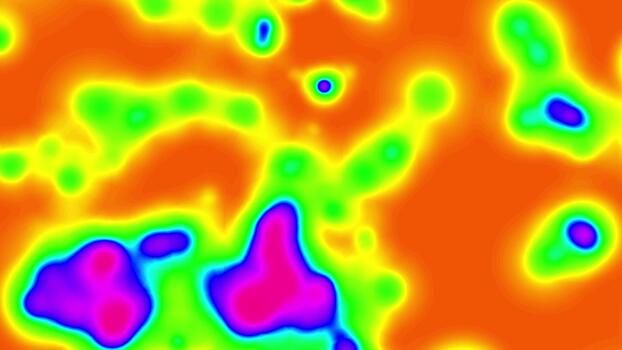
Figure · pedagogical · continuum beside measure
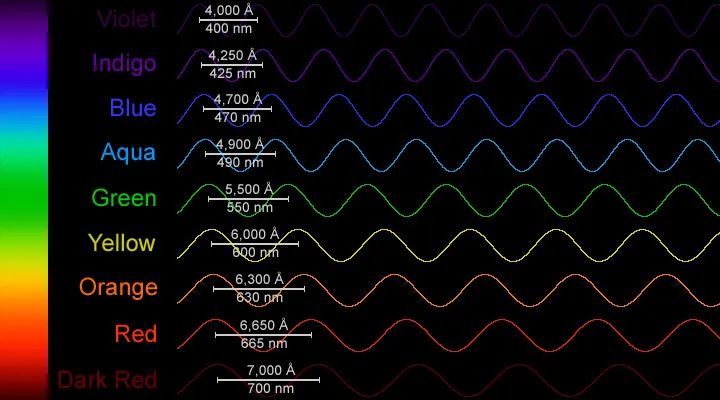
Corpus copies: lit/grant-seed/heatmap-smooth.jpg, lit/grant-seed/spectrum-smooth-striated.jpg. Daily reports that discuss the figures as worked examples remain under Reports.